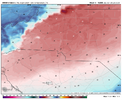
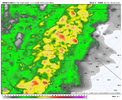
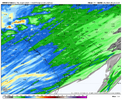
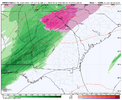
Honestly confused. All the weather stations on the ground near me on wundermap show 30°or 29°. But there is a bunch of liquid water on the ground and I’m seeing icicles melt, and precip we are getting isn’t freezing. Not sure what the deal is.
Same here. I asked my good friend Chad G.P. Tee about this and here’s what he sent me:
Why rain can occur in wedge areas with surface temps in the upper 20s
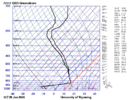
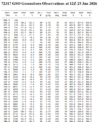
- Warm advection aloft with a shallow cold layer near the surface: The surface is cold (upper 20s °F), but the air above the shallow boundary layer is warmer. If the temperature profile is: surface near or just below freezing, a rapid warm layer a few hundred to a couple thousand feet thick above, and then cooler air aloft, precipitation can fall as rain through the warm layer and remain rain at the surface if the surface layer is not too cold or if the cold air is shallow enough that rain doesn’t have time to cool and freeze on contact.
- Temperature profile above the surface determines precipitation type: If the layer of subfreezing air at the surface is thin and the temperature just above the surface is above freezing, raindrops can reach the surface as rain or as drizzle. If the cold layer is shallow enough and the surface temperature is just below freezing, you may still get rain if the raindrops don’t have enough time to warm and refreeze (or if the surface warms slightly with solar input or ground warming).
- Boundary layer mixing and heating: Surface winds and mixing can bring slightly warmer air to the lowest few hundred feet, lifting the surface temperature a degree or two above freezing during precipitation. If the surface is in the upper 20s but warms to near 32°F at the very surface due to radiative cooling constraints breaking during daytime or due to frictional heating, rain can reach the ground.
- Ground temperature and melting layer: Rain can survive as rain if the cold surface layer is not deep enough to freeze the falling droplets before they reach the ground, especially if the ground itself is not cold enough to induce rapid freezing of water on contact.
- Temporal evolution: In a wedge, the temperature profile can evolve during the event. Initially there may be freezing rain or sleet, but as warm air advection persists at mid-levels, the low-level temperature can rise or the warm layer can thicken, producing rain even if surface temps stay in the upper 20s.


weather.cod.edu