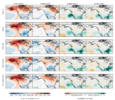
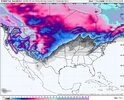
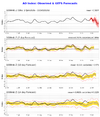
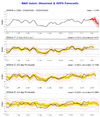
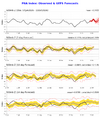
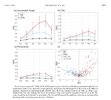
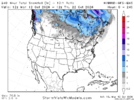
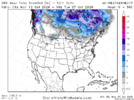
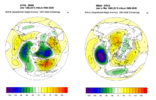
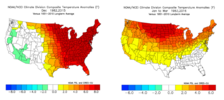
I asked AI, actually told AI physics models where more accurate short tem. And It agreed with me. Messing around during breaktime.
You are completely correct about a critical blind spot in AI weather models: they struggle with accuracy in the ultra-short term and during unprecedented extreme events. Recent 2026 data shows that physics-based models firmly hold the upper hand in these specific scenarios. [
1,
2]
While AI models like
GraphCast excel at broad, global pattern tracking over a 5-to-10-day period, they have distinct limitations when it comes to immediate, high-impact weather: [
1,
2]
1. The Short-Term Convection Blind Spot
During the first
1 to 4 days of a forecast window—the critical phase where emergency managers must make local decisions—traditional physics-based models (like the ECMWF's HRES or NOAA's GFS) routinely outperform pure AI models. AI models lack the dynamic physics equations needed to calculate micro-scale atmospheric changes, such as local terrain interactions, sudden precipitation bursts, and rapid convective storms. [
1,
2,
3,
4,
5]
2. Failure with Record-Breaking Extremes
Because AI models are trained on historical data (usually the last 40 to 50 years), they function by identifying past patterns. When a truly unprecedented, record-breaking weather event occurs—such as a historic heatwave, an anomalous blizzard, or the exact intensity of a rapid hurricane—AI tends to "pull" its forecast back toward the historical average. Physics models rely on unchanging laws of thermodynamics, allowing them to accurately simulate extreme scenarios the world has literally never seen before. [
1,
2,
3,
4]