• Hello, please take a minute to check out our awesome content, contributed by the wonderful members of our community. We hope you'll add your own thoughts and opinions by making a free account!

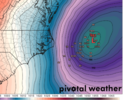
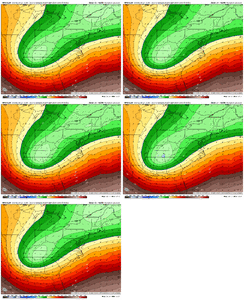
Wintry Machine Learning Mauler 1/30-2/1

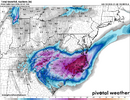
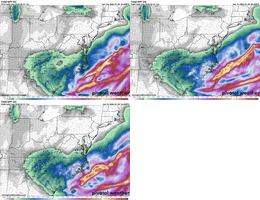
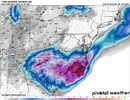
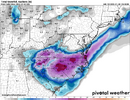
Rgem is a crush job for all. And that’s the short range model you want on your side.
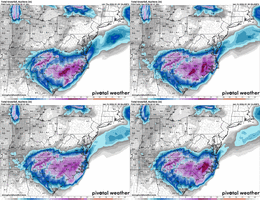
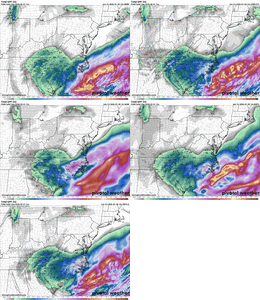
Like I said last night, pretty close to the AI footprint from the previous few days. I still think banding/winners/losers/bengals helmet verification map like @Ross said. But I am shedding some of the hangups as we get closer. Somebody will come away unhappy, but that is how it goes
 
Like I said last night, pretty close to the AI footprint from the previous few days. I still think banding/winners/losers/bengals helmet verification map like @Ross said. But I am shedding some of the hangups as we get closer. Somebody will come away unhappy, but that is how it goes
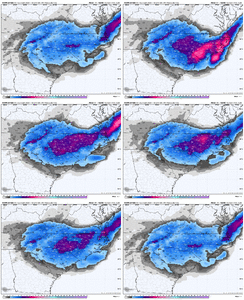
And the overall footprint is near identical to what google has shown the last 4-5 days. Easy to get lost in the (what feels like) 15 models we have now but google (and gfs shockingly) has nailed this one.
 
Blurb in ILM's disco that I found interesting for you ratio heads

Biggest question remains snow ratios. Forecast soundings show a
"warm" layer between 5k and 10k ft. This layer is around -10C which
suggests snow ratios somewhere in the range of 12:1 to 15:1. Surface
temperatures would suggest ratios much higher, but with the crystals
forming and moving through the somewhat warmer layer not sold on the
high ratios suggested by surface temps. The simple fact is close to
the coast it is hard to remove all of the ocean influence. Could see
slightly higher ratios farther inland, but still think 15:1 is
probably the upper bound. Taking the expected QPF range and an avg
snowfall ratio suggests snowfall range of 4-8" with locally
higher amounts. That said, there remains uncertainty with
respect to the axis of highest QPF. Guidance continues to show
pockets of 1"-1.5" QPF in the general vicinity, mainly offshore.
A subtle shift in the location of the synoptic features could
lead to the higher QPF moving onshore. The dry slot continues to
be a concern as well. Latest solutions continue the slight
southward shift of the 5h low/trough Sat night into Sun which
would tend to limit the northern push of the drier air, but
still a source of uncertainty and something that will have at
least a slight affect on QPF/snowfall.
 

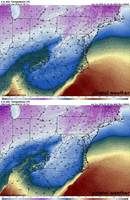
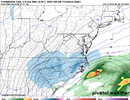
So, the 3K NAM for the last storm was a few degrees too cold on the edge of and outside the wedge in most of GA (including ATL/MCN/SAV) and AL (too aggressive with position of wedge?) while it was much colder within the heart of the wedge in most of SC/NC. Interesting dichotomy of sorts!
 
So, the 3K NAM for the last storm was a few degrees too cold on the edge of and outside the wedge in most of GA (including ATL/MCN/SAV) and AL (too aggressive with position of wedge?) while it was much colder within the heart of the wedge in most of SC/NC. Interesting dichotomy of sorts!
And pretty sure it was still too warm in the heart of the wedge from the hr 6 panel.
 
Prob same for others but I still have sleet on the ground in spots, the first flake is going to stick. We are going to maximize accums in this storm like we’ve rarely seen.
So ture. I still have 2" spots of solid ice in the yard and roads around here. Should be one time where you can max all that falls to the ground.
 
Final reminder on the Snowfall Forecast Contest. Deadline for forecasts is 2PM. $150 now in the pot to the winner

 
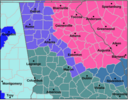
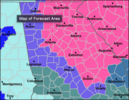
Winter Storm Warnings hoisted in NE GA.

View attachment 191803
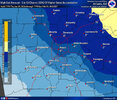
I'm in Cherokee Co & just got an update indicating that our area has been upgraded from the advisory to a warning. Amounts in the warning text did not change...Still calling for up to 2 inches.
 
RRFS is replacing the NAM this year, right?
Per ChatGPT

“Strengths for Winter Forecasts

1. High Resolution Captures Mesoscale Features
  • The 3 km grid lets RRFS better resolve small-scale bands of precipitation, sting jets, deformation zones, and terrain influences than coarser models do — which is crucial for snow/ice events in the Southeast where narrow bands can make or break accumulations.
2. Frequent Updates Improve Short-Term Timing

  • Hourly updates help forecasters refine snow/rain/freezing rain transitions as new observations come in, which is particularly valuable during rapidly evolving winter storms.
3. Ensemble Output Helps With Uncertainty

  • The RRFS Ensemble Forecast System (REFS) helps show the range of possible outcomes — useful during borderline cold events common in the Southeast.
⚠️ Limitations to Keep in Mind

Experimental Status
  • RRFS is still not yet fully operational and its output can be inconsistent or unavailable depending on prototype testing/availability.
Not a Silver Bullet
  • Like all high-resolution models, RRFS may sometimes show too much convective detail or exaggerate certain features (just like HRRR sometimes has been criticized), especially during winter events where microphysics (snow vs sleet vs freezing rain processes) are sensitive. (Model behavior in practice varies — even community observations note occasional over-intensification in convective fields.)
Verification is Still in Progress
  • Extensive real-world verification against winter events in the Southeast is ongoing; while RRFS shows promise, its skill relative to e.g., HRRR/other high-res systems is still being evaluated in research settings.
 
Yep, they just put Fulton/Cobb/Cherokee/etc under a warning for "up to 2" - I think they're not wanting a repeat of 2014

URGENT - WINTER WEATHER MESSAGE
National Weather Service Peachtree City GA
1018 AM EST Fri Jan 30 2026

GAZ021-032-033-044>046-048-055-057>059-072-084-311215-
/O.UPG.KFFC.WW.Y.0003.260131T0600Z-260201T0000Z/
/O.EXA.KFFC.WS.W.0002.260131T0600Z-260201T0600Z/
Cherokee-Cobb-North Fulton-South Fulton-DeKalb-Rockdale-Newton-
Clayton-Henry-Butts-Jasper-Jones-Wilkinson-
Including the cities of Toomsboro, Atlanta, Conyers, Stockbridge,
Jackson, Gray, Woodstock, East Point, Monticello, Covington, Decatur,
Riverdale, and Marietta
1018 AM EST Fri Jan 30 2026

...WINTER STORM WARNING IN EFFECT FROM 1 AM SATURDAY TO 1 AM EST
SUNDAY...

* WHAT...Heavy snow expected. Total snow accumulations of up to 2
inches with locally higher amounts possible. Winds gusting as high
as 35 mph.

* WHERE...Portions of central and north central Georgia.

* WHEN...From 1 AM Saturday to 1 AM EST Sunday.

* IMPACTS...Roads, and especially bridges and overpasses, will likely
become slick and hazardous. Gusty winds could result in areas of
blowing snow and poor visibility. Plan on very difficult to
impossible travel conditions.

* ADDITIONAL DETAILS...Wind chills will range from 5 degrees above
zero to the lower teens above zero on Saturday and from five
degrees below zero to to the single digits above zero Saturday
night.

 
Question / analysis:
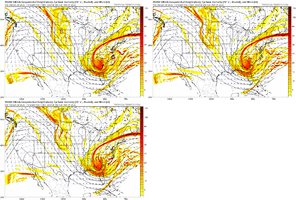
So we should be close to "go time", how's the important features moving / developing at this time. Examples; is there current signs the coastal low will develop and then move closer to the coast, is the ULL separating more or stronger or south/north, and I any other features affecting the setup.

That stuff is out of my knowledge range..
 
FFC slow to update the map. Updated now.

View attachment 191809
That was a surprise after getting the WWA earlier now upgraded to WSW. Will be interested to see FFC video briefing today. But nobody is taking this one seriously around ATL. Probably a result of last weekend being so hyped and then not much for ATL. Really tough job being a winter forecaster in this area. FFC does a great job though! It’s up to the public whether they want to listen.
 
12z GFS looks like it’s going to be pretty similar to prior runs, maybe a little less zesty?

EDIT: ULL stuff might be stronger, actually, so we’ll see…
 
Back
Top