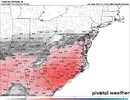
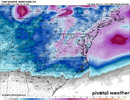
“Where” and “what”I think the question somehow is already becoming "where" and not "if"

“Where” and “what”I think the question somehow is already becoming "where" and not "if"

Almost 100% consensus that a significant winter storm is coming.
View attachment 185290

Did it shift way south?Oh man, I need the pretty WxNext maps from ya @bouncycorn
18z looks like a doozy
View attachment 185312

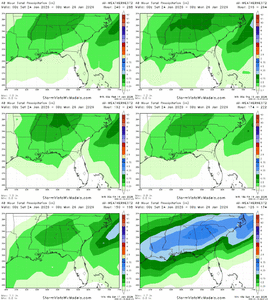


The dark blue line the freezing line on this map?
Darkest blue is surface freezing line, royal blue solid line is 850hPa freezing line. Dashed line 1000-500mb thicknessesThe dark blue line the freezing line on this map?

Oh man, I need the pretty WxNext maps from ya @bouncycorn
18z looks like a doozy
View attachment 185312

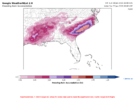
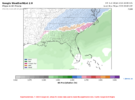
Questions remain regarding where precip may shift to and how thermos respond, but everything is hollering mega CAD mixed bag right now. Thanks so much for these plots, they look great.View attachment 185316View attachment 185317View attachment 185318
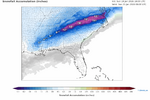
**Snowfall here is only counting snow, and ZR is only counting ZR.. don't have a plot for sleet, so you can fill in the gaps there.

I would just say that even if you have the good players on the field - retrograding Greenland block, low anomaly underneath, etc, it still comes down to the specific details on where those features are located, how they evolve, and how they interact with the storm wave moving in from the SW. A lot of the good storms that hit the Mid-Atlantic and the Northeast also have these features of course, there're just a little farther north when those areas get hit good compared to what we requireSeems like it would be really hard for models to trend stronger with the SE ridge here. You have a perfectly placed block with a polar vortex trapped directly in between it and the southern Atlantic coast. If anything, I’m shocked there can be as much ridging as what’s being shown?
Doesn’t this usually trend towards less ridging, when you have the the players lined up like this?
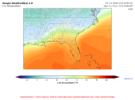

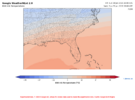
How reliable is the google model? It have a good track record?2m temperature during the peak of the precipView attachment 185320View attachment 185321
Statistically, it is the best model around. That is based on validation that spans multiple years (2022 to present).How reliable is the google model? It have a good track record?
Is there a 925 and 850 and 700mb temp on there?2m temperature during the peak of the precipView attachment 185320View attachment 185321
Had ChatGPT make it into a snowfall map. Dunno if that’s reliable enough.2m temperature during the peak of the precipView attachment 185320View attachment 185321
Is there a 925 and 850 and 700mb temp on there?
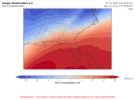


really interesting that this ai model displayed the exact same lurch upward in qpf the ai ero ens showed over the last two model cycles

The CAD in Georgia seems rather anemic as depicted by the model. Just doesn't have that classic tongue of cold air sharply into Atlanta and points north and east. I'm still trying to get used to these new Al models. I presume details are smoothed a bit?2m temperature during the peak of the precipView attachment 185320View attachment 185321
If you watch them both closely they are often pretty much right with each other. Did @bouncycorn say they run off the euro IC?really interesting that this ai model displayed the exact same lurch upward in qpf the ai ero ens showed over the last two model cycles
Yes, most likely sleet. Or at least a rain/sleet mix.Would a 850 mb temp above freezing and a 925 mb temp below freezing, as well as the surface, likely mean sleet?
They initialize with the same initial conditions, have the same training data (ERA5 since 1980), and very similar model architectures (CRPS-optimized GNN-Transformer ensemble, difference is AIFS-ENS injects high dimensional noise across the model while WeatherNext2 injects low dimensional noise across the model.. WxNext2 noise injection is the better method in testing)really interesting that this ai model displayed the exact same lurch upward in qpf the ai ero ens showed over the last two model cycles

View attachment 185316View attachment 185317View attachment 185318
**Snowfall here is only counting snow, and ZR is only counting ZR.. don't have a plot for sleet, so you can fill in the gaps there.
ok makes total sense. really enjoyed picking your brain about these things last few daysThey initialize with the same initial conditions, have the same training data (ERA5 since 1980), and very similar model architectures (CRPS-optimized GNN-Transformer ensemble, difference is AIFS-ENS injects high dimensional noise across the model while WeatherNext2 injects low dimensional noise across the model.. WxNext2 noise injection is the better method in testing)
From one of my friends in AmericanWX:Valid question IMHO. Assuming 10:1 ratios (as shown) - given the cold projected, is 15:1 or even 20:1 possible? My guess is its too early to know?
I pressed a random point in North Carolina on OpenSnow (company I work for) and it has ratios around 14:1 to 15:1. We have a very strong algorithm for calculating snow ratio.Valid question IMHO. Assuming 10:1 ratios (as shown) - given the cold projected, is 15:1 or even 20:1 possible? My guess is its too early to know?

i've always thought thinking about this stuff at this point in the event is getting greedyValid question IMHO. Assuming 10:1 ratios (as shown) - given the cold projected, is 15:1 or even 20:1 possible? My guess is its too early to know?
Ask away. Love explaining these things as many/most meteorologists don't understand them well. I spoke at a meteorologist conference last week in Tahoe about AI-weather and speaking at one this week in Colorado. All about these models (and more!).ok makes total sense. really enjoyed picking your brain about these things last few days
i've always thought thinking about this stuff at this point in the event is getting greedy


Maybe SouthernWx needs a Youtube video, question and answer session with you about AI-weather.Ask away. Love explaining these things as many/most meteorologists don't understand them well. I spoke at a meteorologist conference last week in Tahoe about AI-weather and speaking at one this week in Colorado. All about these models (and more!).
Is that freezing rain map you made a stock qpf below 32? Or is it trying to factor in temps/rain rates/runoff/etc?Ask away. Love explaining these things as many/most meteorologists don't understand them well. I spoke at a meteorologist conference last week in Tahoe about AI-weather and speaking at one this week in Colorado. All about these models (and more!).
QPF below 32F from period start to finish. weathernext2 (and other models) provide QPF total over 6 hour windows but temp at the times themselves, so if the ptype is ZR at start and end, it is counted. I reduce the ratio from 1:1 when either the start is above freezing or end is above freezing. And keep in mind, weathernext is an ensemble of 64 members, so we do this for each member and plot the mean.Is that freezing rain map you made a stock qpf below 32? Or is it trying to factor in temps/rain rates/runoff/etc?
haha didn't mean to come across as snide. but even with the signal, beginning to talk ratios to me is ultimate hubris for a storm 6 days awayThank you, Ross. I was simply trying to understand this newer methodology. Please forgive me if I was coming across as greedy.
there any good articles, journals, reading material you can recommend about this stuff?Ask away. Love explaining these things as many/most meteorologists don't understand them well. I spoke at a meteorologist conference last week in Tahoe about AI-weather and speaking at one this week in Colorado. All about these models (and more!).
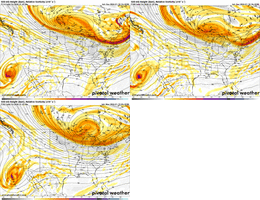

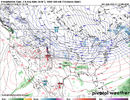

Interesting shift by the ICON at hour 102. Pulling the Baja energy further east
View attachment 185332