Drizzle Snizzle
Member
I wasn't aware March was the middle of winter.So excited we’re kicking off severe season in the middle of winter! View attachment 194674View attachment 194675

I wasn't aware March was the middle of winter.So excited we’re kicking off severe season in the middle of winter! View attachment 194674View attachment 194675

In Iowa it isI wasn't aware March was the middle of winter.

In Iowa it is
Since it can snow in May , back in the good ole days

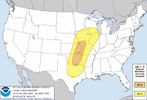
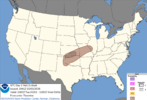

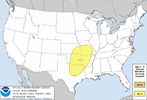
Guess this counts as the first ever hatched area on a marginal risk day. CIG1 for hail in OK/KS.View attachment 194697
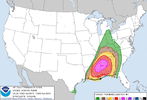
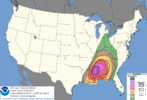
There’s more depending on whether is wind, tornado, or hail is my understanding… fox weather channel did a pretty in depth explanation tonight.. I think hail has 2.. wind has 3 .. and tornado has 4 or 5 categories ( I know there’s 5 strengths of tornados obviously just talking their shaded categories)… it’s different for sure.. what’s funny is they showed these sample maps with high categories around the ATL metro and I was like damn … if only I had this to track lolWait, so we have two hatched levels now? Good grief.
There’s more depending on whether is wind, tornado, or hail is my understanding… fox weather channel did a pretty in depth explanation tonight.. I think hail has 2.. wind has 3 .. and tornado has 4 or 5 categories ( I know there’s 5 strengths of tornados obviously just talking their shaded categories)… it’s different for sure.. what’s funny is they showed these sample maps with high categories around the ATL metro and I was like damn … if only I had this to track lol
That is insanity...
It’s actually a good thing IMO. The new system separates maximum expected intensity from probabilities. It gives a lot more granularity, especially in high coverage low intensity events (i.e feeder bands in a hurricane) and low coverage high intensity events (i.e stout EML cases in the plains).

Exactly. It's overkill and will just confuse the general public. The severe risk categories are already confusing enough. That's why WRAL just says levels 1 to 5. They probably only need 4 levels anyway. Just use low, medium, high and extreme. The ones they have now don't make sense when slight and marginal means the same thing, and something that is enhanced is actually greater than something that is moderate.And will do nothing more than confuse the public and be disregarded.
Think about it this way, right now we have two tornado warnings, regular and tornado emergency. When the TE is issued it grabs eyes because it is simple and shows extreme danger.
If we had Tornado warning levels one through ten, you water down the lower tiers( oh its just level three, it won't be bad)
Adding multiple threats of hatching to already expanded risk levels is just goofy. We don't need to expand the SS to Cat one though ten, nor do we need fifteen EF levels.
Hatching alone was plenty significant enough.
And will do nothing more than confuse the public and be disregarded.
Think about it this way, right now we have two tornado warnings, regular and tornado emergency. When the TE is issued it grabs eyes because it is simple and shows extreme danger.
If we had Tornado warning levels one through ten, you water down the lower tiers( oh its just level three, it won't be bad)
Adding multiple threats of hatching to already expanded risk levels is just goofy. We don't need to expand the SS to Cat one though ten, nor do we need fifteen EF levels.
Hatching alone was plenty significant enough.
I'd argue that SPC convective outlooks aren't intended for the general public - more so for local WFOs, media, emergency managers, etc...
Even when the public uses SPC outlooks, I bet the majority of the time they are focused on the categorical outlooks instead of the probabilities. The general public, in general, has extremely poor understanding of probabilities (the same reason people gripe when they get a thunderstorm in the summer with a 30% POP - even though the forecast itself may be perfectly fine), especially if they lack the framework to properly contextualize it.
A 10% probability of tornadoes within 25 miles of a point, while not a generational outbreak, is nothing to scoff at. However if someone hears that without understanding that 10% is significantly higher than the background probability on a random day, their first thought is probably that 10% "isn't that high"
A point brought up in the video I linked that I think some people are missing is being able to (mostly) separate categorical outlooks from probabilities and intensity allows the categorical outlook to focus on the expected impact of the event - which arguably makes it a much more useful product.
The example of a tornado warning doesn't hold up IMO. A tornado warning is a short fused product intended for widespread dissemination and immediate action - it has to be "short and sweet". A SWODY1 doesn't have the same impetus and can afford to be more granular.
Breaking the SS scale into "1 through 10" and the EF scale into "15 different levels" isn't what anybody is proposing or what is happening. The categorical outlooks aren't changing - all that's happening is changing SIG severe from a binary yes/no to a system that gives the forecaster the ability to better communicate the forecasted intensity. Previously, a hatched area could mean one or two EF2 tornadoes or it could mean multiple long track, violent tornadoes - two vastly different situations but previously they had the same treatment on the graphical outlook.
It's perfectly OK to have a forecast not intended for every member of the general public - there's a reason that SPC issues Public Severe Weather Outlooks during high impact days.
But isn't this entire argument counter-intuitive? If the SPC forecasts are arguably not intended for the public, then why further complicate a system for those who already know how to read the maps?
For instance does the map *need* to differentiate EF2+ VS long track tornadoes? No. That is what the forecast discussion is for.
But what it could do is add even failure points and busts.
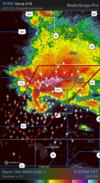
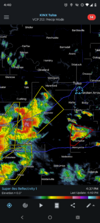
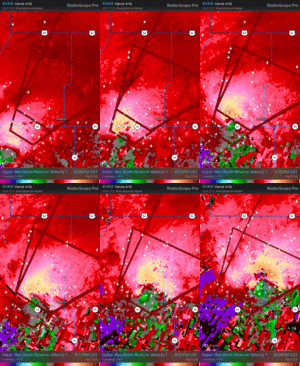
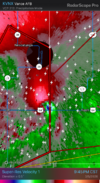
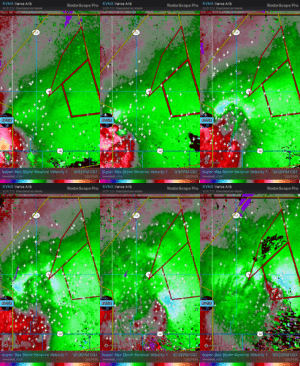
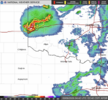
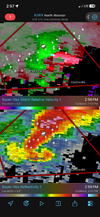
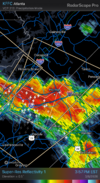
Classic looking supercell in NW Oklahoma right now.View attachment 194739



Not sure where they got thatWRAL saying we're now under a level 3 risk Sunday
It was a typo on Facebook. It's a level 1 risk.Not sure where they got that


 www.broadcastify.com
Interesting to note the HRRR has been struggling pretty bad with storm placement so far. Seems like storms have formed further west then its been showing.