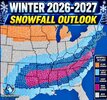
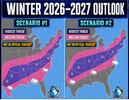
This is somewhat informative. I just asked ChatGPT the following:
“For each of the last 10 years, what did CFSv2/NMME/ECMWF predict in August for the coming DJF, what actually happened, and how accurate was each forecast?”
The reply:
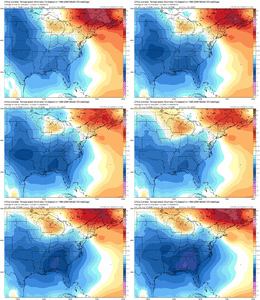
I went back through the NOAA/NMME and CFSv2 archives and the ECMWF seasonal verification material. The important thing is that there is no official NOAA table giving an annual “CFSv2 score” and “ECMWF score” for each August forecast. So I reconstructed the comparison using the August-issued DJF temperature signal and then verified it against the observed DJF pattern, with particular attention to the Southeast/Mid-South because that’s the region relevant to your North Alabama location.
NOAA’s archives explicitly preserve the August forecast runs and their subsequent DJF verification, and NMME’s verification system labels August → DJF as a specific lead-4 seasonal forecast.
August → DJF: last 10 winters
Legend:

= good directional forecast

= mixed/partially useful

= poor
Score is my directional verification of the Southeast/Mid-South temperature signal, not an official HSS/RPSS value.
| August forecast | CFSv2 signal | NMME mean | ECMWF | What actually happened | Overall |
| 2016 → DJF 16-17 | Warm East/Southeast | Warm East | Warm North America | Very warm South/East; LA/TX record warm | 🟢 Good |
| 2017 → DJF 17-18 | Warm East/South | Warm East/South | Warm East | Warm winter overall; East particularly warm | 🟢 Good |
| 2018 → DJF 18-19 | Warm Southeast / mixed West | Warm South/East | Warm East, colder West | Southeast very warm; AL/TN among top-10 warmest | 🟢 Good SE |
| 2019 → DJF 19-20 | Warm CONUS | Warm CONUS | Warm CONUS | 6th-warmest CONUS winter; East very warm | 🟢 Excellent |
| 2020 → DJF 20-21 | Warm Southeast, colder central | Warm East/South, mixed central | Warm East/North, mixed central | Southeast warm overall but huge Feb Arctic outbreak | 🟢/🟡 Good seasonal mean |
| 2021 → DJF 21-22 | Warm Southeast | Warm Southeast/East | Warm Southeast/East | Southeast warm; GA/SC 7th-warmest | 🟢 Good |
| 2022 → DJF 22-23 | Warm Southeast/East | Warm East | Warm East | South/East warm; several states top-10 warmest | 🟢 Good |
| 2023 → DJF 23-24 | Very warm | Very warm | Very warm | Warmest U.S. winter on record | 🟢 Excellent |
| 2024 → DJF 24-25 | Warm South/East | Warm South/East | Warm South/East | Warm winter; Southeast/Gulf Coast warm | 🟢 Good |
| 2025 → DJF 25-26 | Warm South/West, colder Northeast | Warm South/West | Warm South/West | 2nd-warmest CONUS winter; South 2nd warmest | |
A few of these are particularly telling
2016-17: ECMWF explicitly reported that its seasonal forecast captured the broad warm anomalies over North America reasonably well. The actual winter had exceptionally warm conditions from the Southern Plains to the East Coast, with Louisiana and Texas recording their warmest winters on record.
2018-19: This is a very useful case for you. The winter ended up warm across the Southeast despite some spectacular cold episodes. Alabama, Georgia, Tennessee and Florida all had top-10 warm winters. ECMWF’s verification, however, shows that it had trouble with the broader North American pattern—particularly the cold Canadian/western U.S. anomaly.
2019-20: One of the easiest winters for the models because the large-scale signal was strongly warm. The actual CONUS winter was the 6th warmest on record, with much-above-normal temperatures across most of the East.
2020-21: This illustrates why a seasonal mean can be misleading for snow. The winter averaged warm across the CONUS, including portions of the Southeast, but February produced the extraordinary Texas/Deep South cold outbreak. A model can therefore get the DJF mean direction correct while completely missing a major snow/ice-producing month.
2021-22: Again, the Southeast signal was quite good. The actual winter was above normal across much of the Lower 48, with Georgia and South Carolina having their 7th-warmest winter on record.
2022-23: The models correctly anticipated the broad warm East/Southeast background despite La Niña. Actual winter temperatures were above normal from the southern Plains through the East Coast; several eastern states had their second-warmest or top-10 warmest winter. ECMWF’s own review says its forecast did predict the warm U.S. signal, although it overdid the north-south temperature gradient.
2023-24: This was another relatively easy case because of the strong El Niño/global warmth. The actual DJF was the warmest winter on record for the Lower 48.
2024-25: The actual winter averaged 1.9°F above normal for the CONUS, with much of the country near or above normal.
2025-26: This one is particularly interesting because it is the most recent analogue. Despite significant January cold and major wintry weather across the South and East, the seasonal mean ended up 4.9°F above the 20th-century average and second-warmest on record, with the NOAA South region ranking second warmest.



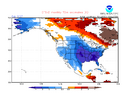
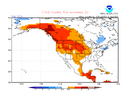

 Last six-incher for me was 6.5” in February 2015 when I still lived in the Triad.
 Last six-incher for me was 6.5” in February 2015 when I still lived in the Triad.