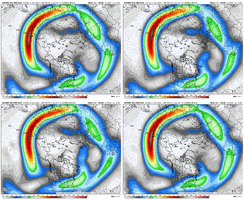
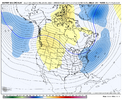
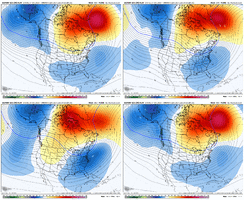
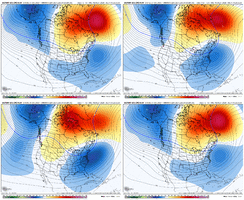
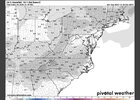
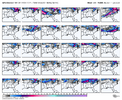
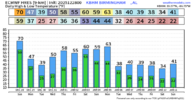
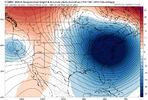
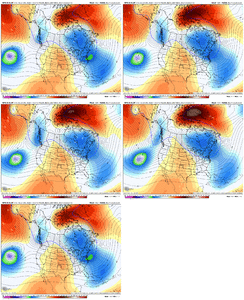
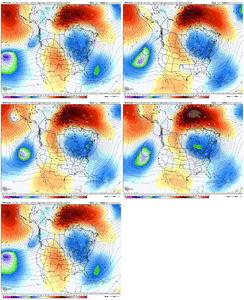
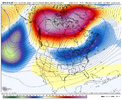
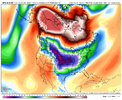
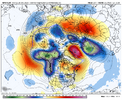
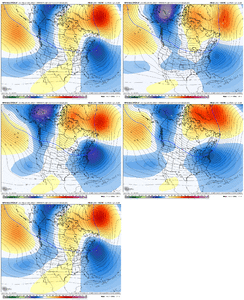
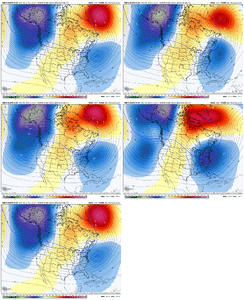
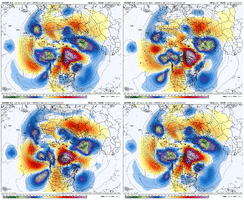
There is much to talk about as we start the New Year. As we close out the month of December, the analog forecasts for temperature and 500MB were quite close to reality. The warmest air was across the West and south central, while the Midwest, Great Lakes and the Northeast were somewhat colder than average (and connected to widespread, extreme cold in much of Canada and Alaska. The storm scenario was a sprawling vortex below the Aleutian Islands and in the Gulf of Alaska. That set-up was very wet for the shoreline of the immediate West Coast and helped to build a humongous, dense snow cover along and north of the International Border. One important detail is the sea ice extent, which now covers Hudson Bay and the Davis Strait. You will recall that in previous mild years the ice formation was very limited. Things are still changing, and may leave the lower 48 states vulnerable to a more serious encounter with cold and snow.
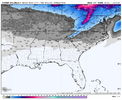
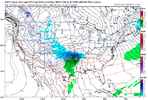
The ENSO 3.4 signature is at a moderate La Nina stage, and probably will not start to warm until mid January. If the central Pacific Ocean starts to warm (unlike now), Kelvin wave penetration will increase and the cooler SST values nearer the Galapagos Islands will start to warm. Ascendant negative neutral character (that is moving toward a weak El Nino designation in winter is very favorable for major frozen precipitation events when baroclinicity is well defined. The familiar "Southeast Ridge" has been weaker than forecast and may assume a more Bermuda High position and strength during the middle of next month. So after what should be a cold exit from 2025 to the first week of 2026 (replete with a winter storm east of the Rocky Mountains), we could see a viable candidate for a "January Thaw" followed by a snow and ice debacle that leads into a rather cold, and active, February 2026.
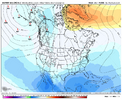
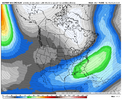
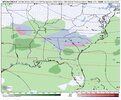
But I urge diligence and caution in the 11-15 and 16-20 day range simply because many folks seem hell-bent of following only the weather forecast models (which were often too variable if not wildly inaccurate) and the various climatic indices in alerting the public and business world about temperature and snow/ice threats. I state my fond axiom about Prediction: it is not a bingo game! Just because someone tells you that the MJO is in Phase 8 does not mean that a) this will happen, or b) Philly can expect abundant snowfall. Simply check out systems on satellite imagery of the temperature and precipitation array and look at its progress toward and through the USA. The best outlooks come about from climatology + persistence + model examination.
It takes much more time, but will feel better for it. And do not get me started about QBO and SSW!
Prepared by Meteorologist LARRY COSGROVE on
Saturday, December 27, 2025 at 10:35 P.M. CT